Lawyers defending Saddam Hussein have filed a formal motion seeking the disqualification of the chief judge, Rauf Abdel-Rahman.
Abdel-Rahman only began presiding over the trial last month, after his predecessor resigned having been criticised for being lenient.
Ramsey Clark, a former US attorney general and on Saddam's defence team, said about Abdel-Rahman:
"(he) is not impartial and has a manifested bias against defendant..Repeatedly violated standards of fair trial, human rights and basic due process in the courtroom."
Clark also said that Saddam may be allowed to meet with his lawyers, but that has yet to be confirmed.
The trial resumes on February 28th.

Friday, February 24, 2006


Thursday, February 23, 2006
AWB Scandal Continues
The scandal hit Australian wheat exporter, AWB, continues to attract the headlines in respect of its alleged kickbacks to Saddam Hussein.
AWB chairman Brendan Stewart told shareholders at yesterday's AGM, that he regrets the damage caused to AWB's reputation, by its role in the Iraqi oil for food program.
However, he refused to answer questions on issues relating to the scandal.
One shareholder demanded that the board be dissolved, another demanded that the directors step aside and another demanded that the election of directors be postponed until after the Cole Commission into the $300M kickback affair has released its findings.
Stewart did not accept these calls, and was re-elected unopposed.
However, there are rumours that Stewart, who is no longer going to Iraq as part of a trade delegation, was dumped after a federal cabinet discussion.
Wednesday, February 22, 2006
Bush Cherry Picked Reason For War
Paul Pillar, a former CIA National Intelligence officer with 28 years' experience, has set the cat amongst the pigeons in an article that he has written for the journal Foreign Affairs.
In the article he alleges that the Bush administration selectively chose parts of intelligence (ie "cherry picked") to justify its decision, already made, to invade Iraq.
The Administration has repeatedly denied manipulating intelligence.
Vice President Dick Cheney said last year:
"What is not legitimate, and what I will again say is dishonest and reprehensible, is the suggestion by some U.S. senators that the president of the United States or any member of his administration purposely misled the American people on prewar intelligence."
Intelligence officers have insisted that they did not distort the intelligence to satisfy the administration.
In a VOA interview, Paul Pillar alleges that Administration officials wanted to demonstrate a substantive link between Saddam Hussein's regime and al-Qaida. He notes that no such links existed.
Quote:
"The main thing that happened there, particularly with reference to this issue of, was there a relationship between the Saddam regime and al-Qaida -- was a selective use of bits and pieces of reporting to try to build the case that in this case there was some kind of alliance without really reflecting the analytic judgment of the intelligence community that there was not."
Pillar claims that, whilst there was no direct pressure to alter intelligence analyses, the Administration's determination to go to war created a climate that cut off objectivity and stopped dissenting views among intelligence analysts.
Quote:
"If, instead, the analyst is operating in an environment in which he knows decisions have already been made, in which he knows the policymaker has a particular preference for what would suit his purposes in mustering support for that decision..well, that's an entirely different sort of thing."
The question that the American people need to ask is this:
Did President Bush take us to war to avenge his father, and use "exaggerated" intelligence to justify that decision?
Tuesday, February 21, 2006
Iraq Rejects Australian Wheat
On Sunday, a senior official with the Grain Board of Iraq told Dow Jones Newswires that it will buy a "good amount" of wheat from the U.S., Canada and Europe in its latest tender.
However, it would not buy Australian grain.
Wilson Tuckey, a former Australian minister, said that this rejection could be because of the kickbacks allegedly paid to Saddam Hussein's regime by AWB the Australian wheat monopoly.
Quote:
"If 300 million (Australian) dollars went to someone who then used it buy ammunition and blow up my people, as a Shiite, I'd be uncomfortable about doing business with them."
Australia is currently conducting an inquiry into whether AWB breached Australian law by paying US$221.7M million in kickbacks to Saddam Hussein's regime, during the UN oil-for-food program.
Iraq has suspended dealings with AWB until after the completion of the Australian inquiry, which is scheduled to report to government by March 31.
A clear cut case of what goes around, comes around.
This is a very good lesson for all companies to learn from, that they would be wise to take on board, namely; ensure that all business deals are ethical.
Monday, February 20, 2006
State Department Says That Iraq Needs Help
John Bellinger, State Department legal adviser, said in a briefing in Washington on the 15th that Iraqi officials need the world's help to document the abuses of Saddam Hussein's regime.
Quote:
"This is a process that the Iraqis want to do themselves. They have experienced judges who are leading this process".
Bellinger claims that Iraq needs forensic experts to investigate mass grave sites, support for witness interviews and protection and legal experts to advise prosecutors.
Bellinger said that the Iraqi Special Tribunal originally mandated the assignment of international advisers to the court, but few countries have stepped forward to join the United States in that role.
Bellinger is quoted as saying:
"The international community has essentially turned its back on justice and accountability in Iraq."
It seems as though Washington is becoming worried about the handling of the trial, and the negative impact that it will have in the US.
Friday, February 17, 2006
AWB Tax Scandal
The Australian wheat exporter, AWB, is alleged to have claimed up to $90M in tax deductions for its kickbacks to Saddam Hussein's regime.
AWB also allegedly wrote off against tax a $US7M debt it retrieved from the Iraqi Government for a BHP-related company.
AWB is undergoing an investigation by the Cole commission.
Labor's revenue spokesman, Joel Fitzgibbon, said that tax commissioner Michael D'Ascenzo must immediately audit AWB's books to ensure they had not broken any laws.
Australian Federal Police (AFP) Commissioner, Mick Keelty, said that his officers were ready to investigate whether AWB had broken any domestic laws.
Quote:
"We have been liaising with the Cole inquiry and we are awaiting any referral from the Cole inquiry. In order to maintain the integrity of investigation that may have to take place, it's probably appropriate that we say little more than that."
What goes around, comes around!
Thursday, February 16, 2006
Warnings Unheeded
Saddam Hussein has reportedly told aides that he warned the United States before 1990 that terrorists would carry out a major strike on America, with even the possibility of a nuclear attack being mooted.
These warnings come from secret tapes that have been acquired by ABC. The tapes present a voice, allegedly Saddam's, speaking in the presidential palace in the 90's.
Quote:
"Terrorism is coming. I told the Americans a long time before August 2 and told the British as well and that in the future there will be terrorism with weapons of mass destruction."
Adding:
"In the future, what would prevent a booby-trapped car causing a nuclear explosion in Washington, or a germ or a chemical one?"
Interestingly he is also noted as saying that Iraq would not contemplate doing that.
Wednesday, February 15, 2006
Saddam On Hunger Strike
Saddam Hussein as told the court that he and his seven co-defendants haven't eaten for the past three days, to protest at the way they claim to have been treated by the tribunal.
Quote:
"We have been on hunger strike for three days to protest the way they brought us to court."
Defence lawyers are boycotting the court, saying that Rahman is biased and the trial is unfair.
Monday's hearing featured the testimony of a former intelligence officer.
Quote:
"We have been on hunger strike for three days to protest the way they brought us to court."
Defence lawyers are boycotting the court, saying that Rahman is biased and the trial is unfair.
Monday's hearing featured the testimony of a former intelligence officer.
A Day at The Circus
The farce of the trial of Saddam Hussein continued on Sunday, when Saddam clashed with the chief judge accusing the court of forcing him to attend.
Saddam started by accusing his jailers of dragging him into the courtroom, then called the chief judge Raouf Abdul Rahmann ignorant and insignificant.
The judge, not surprisingly, did not take this too kindly and banging his gavel on the bench ordered Saddam to be silent.
Saddam's half-brother Barzan al-Tikriti scuffled with guards as he was brought in, he then shouted at the judge before sitting on the floor with his back to the bench.
The court was adjourned when two former aides of Saddam Hussein refused to answer questions, with one saying he would never testify against his president.
A farce as usual.
Friday, February 10, 2006
Saddam Banned in Belgium
The Belgians are having something of a debate about artistic freedom of speech.
David Cerny is one of the country's most original and provocative visual artists.
His work includes giant black babies that crawl up Prague's Zizkov TV tower, and the Pink Tank a memorial to the liberation of Czechoslovakia in 1945.
However his latest work, "Shark", is causing hackles to rise.
"Shark" is a sculpture of a life-size Saddam Hussein in underpants with his hands tied behind his back, floating in a large glass tank filled with the embalming fluid formaldehyde.
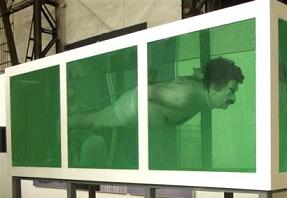
The sculpture was supposed to be exhibited as part of this April's Beaufort 2006 Modern Arts Festival, in the Belgian town of Middelkerke.
However, Michel Landuyt the mayor of Middelkerke has banned it. He claims that it's far too provocative.
Isn't that the point of "cutting edge" art?
He is basing his decision on the furore over the Danish cartoons.
Landuyt told Radio Prague there are several reasons why the sculpture is inappropriate:
"Families with children pass by the square that it was to stand on and some of them may not have taken it too well.
The other thing that bothers me is that the exhibit portrays an almost deformed human being, a real person, who is still alive.
He is in trial but should be presumed innocent until proven guilty. And lastly, I don't want to provoke people... or a certain group of people."
Good art is provocative and thought provoking, the bland chocolate box art beloved of dictators and the repressed does nothing for society.
David Cerny decided to make the sculpture of Saddam Hussein, after he witnessed the aftermath of the Iraqi dictator's reign during a week-long stay in Baghdad.
He is quoted as saying:
"I don't think that a wave of censorship has hit us but what is worrying is that it is now affecting the everyday lives of the ordinary citizens of this continent."
The sculpture will most likely be exhibited at the Museum of Modern Art, in the nearby city of Oostende.
David Cerny is one of the country's most original and provocative visual artists.
His work includes giant black babies that crawl up Prague's Zizkov TV tower, and the Pink Tank a memorial to the liberation of Czechoslovakia in 1945.
However his latest work, "Shark", is causing hackles to rise.
"Shark" is a sculpture of a life-size Saddam Hussein in underpants with his hands tied behind his back, floating in a large glass tank filled with the embalming fluid formaldehyde.

The sculpture was supposed to be exhibited as part of this April's Beaufort 2006 Modern Arts Festival, in the Belgian town of Middelkerke.
However, Michel Landuyt the mayor of Middelkerke has banned it. He claims that it's far too provocative.
Isn't that the point of "cutting edge" art?
He is basing his decision on the furore over the Danish cartoons.
Landuyt told Radio Prague there are several reasons why the sculpture is inappropriate:
"Families with children pass by the square that it was to stand on and some of them may not have taken it too well.
The other thing that bothers me is that the exhibit portrays an almost deformed human being, a real person, who is still alive.
He is in trial but should be presumed innocent until proven guilty. And lastly, I don't want to provoke people... or a certain group of people."
Good art is provocative and thought provoking, the bland chocolate box art beloved of dictators and the repressed does nothing for society.
David Cerny decided to make the sculpture of Saddam Hussein, after he witnessed the aftermath of the Iraqi dictator's reign during a week-long stay in Baghdad.
He is quoted as saying:
"I don't think that a wave of censorship has hit us but what is worrying is that it is now affecting the everyday lives of the ordinary citizens of this continent."
The sculpture will most likely be exhibited at the Museum of Modern Art, in the nearby city of Oostende.
Subscribe to:
Posts (Atom)